
How to Make The Perfect Chocolate Martini
Check out what happened when 2 of Stint’s student partners came in and made our indulgent Chocolate Martini with our Head of People and Ex-Drinks Innovation Manager Chance! Simple to…



England World Cup history is not something you half-watch with one eye on your inbox. It belongs on big screens, with pints on tables and a room ready to lose its head together.
That is the point. These tournaments are not just a stack of old highlights and pub-quiz answers. They are national flashpoints. Glory, penalties, redemption arcs, daft hype, proper belief, and the usual emotional theft. England have produced all of it, and the only sensible way to live those moments is in a packed sports bar, not slumped over a laptop listening to delayed commentary through tinny speakers.
The old highs still matter, of course. So do the near misses. But this is not a museum tour for people who clap politely at black-and-white footage. It is a reminder that England at major tournaments always drags people together. Strangers start talking. Every decision gets judged like a court case. One goal can turn a noisy room into bedlam.
Belushi’s has venues across major European cities, including London, Edinburgh, Paris, Amsterdam, Berlin, Vienna, Barcelona, and Newquay. That matters because setting matters. If you want the full noise, the tension, and the shared meltdown that comes with England at a major tournament, start with a place built for live sport. You can keep tabs on World Cup matchday action and tournament events at Belushi’s.

If you’re the sort who loves silverware, side quests, and football history that means something, this piece on essential football trophies for fans is worth a look too.
This is the one that still gives every England campaign its swagger. One men’s World Cup changes the mood of every tournament conversation, and 1966 owns that status because England finished the job, at Wembley, with the whole country watching itself become a football nation in real time.
Geoff Hurst made sure nobody could file it away as a dusty old win. A hat trick in a World Cup final will do that. So will a match packed with chaos, argument, pressure, and the sort of drama fans still end up shouting about half a century later.
Because it is not tidy. The famous second goal is still a pub argument with footage. Good. Football history should have a bit of menace to it. If everyone agrees on everything, you are not talking about a great final. You are revising for an exam.
That is why 1966 works so well in a proper sports bar. Put that final on a big screen and the room starts doing what England football nights always do. Strangers turn into instant selectors. Every replay gets judged like a criminal trial. For a match night built around old England highs, start with Belushi’s World Cup screenings and tournament nights and give the game the setting it deserves.
Practical rule: Open with 1966 if you want the room alive early. It gives older fans the memory, younger fans the mythology, and everyone else a reason to argue at full volume. Tiny screens and limp atmosphere can get in the bin.
Italia 90 gave England a striker worth building a campaign around, and Gary Lineker repaid that faith by turning half chances into national obsession. He was ruthless without the nonsense. No flashy waste, no pointless posing, just sharp movement, cold finishing, and the sort of tournament nerve England have spent years begging for since.
That run still matters because it set a standard. If your number nine goes missing in a major tournament, you go home. If he stays alive in the box and punishes mistakes, suddenly the whole country starts planning its week around kickoff.
Because it felt like England had the right centre-forward at exactly the right time, then got handed the usual dose of suffering anyway. That combination sticks. Great goals followed by familiar pain is basically part of the national football archive.
And Lineker gave the campaign its edge. He made tense matches feel salvageable. One loose touch, one clever run, one finish hit early, and the mood changed. That is why old clips from 1990 still work in a packed bar. The room knows what is coming, but everyone still reacts. A proper sports bar turns memory into theatre. A laptop turns it into homework.
Use that tournament for what it offers:
Italia 90 was not silverware. It was something messier and, in its own way, more familiar. Hope with bite, followed by pain in public. England fans know that script by heart. They should watch it somewhere with noise, decent screens, and a room full of people ready to wince at the same moment.
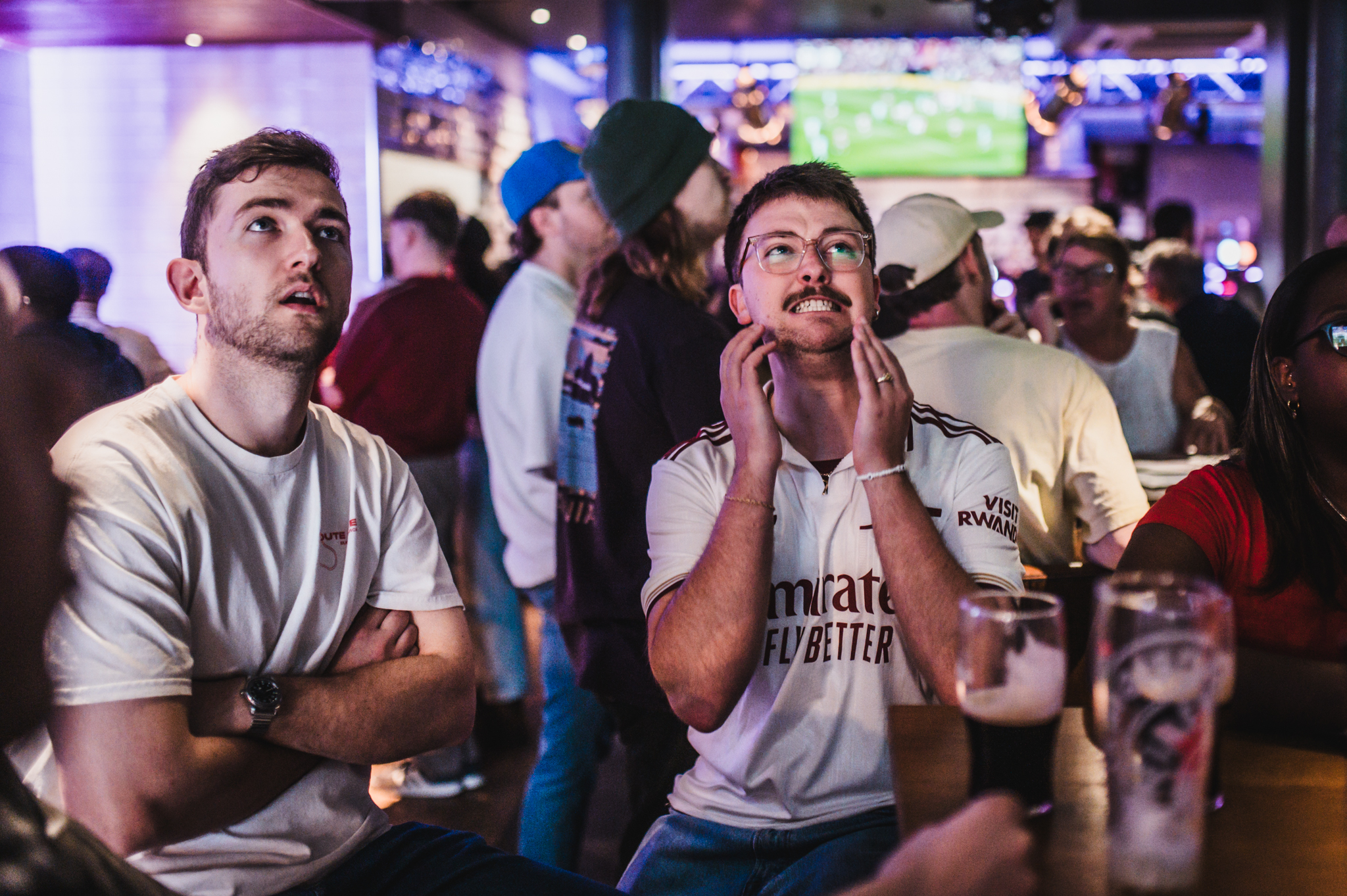
Euro 96 gets polished far too kindly. England did not win it. England did not even reach the final. What it did produce was one of the great national football moods, and that matters because tournament memory is built as much from shared feeling as silverware.
That summer stuck because the whole country got dragged into it. Wembley was loud, the soundtrack was everywhere, and every match felt like public business. Fans were not merely checking scores in the corner. They were packed into pubs, arguing over lineups, singing before kickoff, and living every swing of the game together.
That is why the nostalgia works. It is not only about Gascoigne’s brilliance or the usual ache at the end. It is about the room.
Watching those moments alone misses the point. England at a major tournament is a social sport. You need the groan when a chance goes begging, the idiot at the bar calling for a substitution too early, and the bounce when a whole place believes for ten wild seconds that history is about to behave itself.
Belushi’s gets a mention here for a simple reason. Big England games need big screens, noise, and zero apology for caring too much. A proper sports bar turns memory into an event again. A laptop turns it into background content, which is a miserable way to treat football that was built for chaos and company.
Euro 96 is remembered so fondly because it felt like England belonged to everyone for a few weeks.
So be honest about it. Stop talking about Euro 96 like it was some glorious triumph stolen by fate. It was a brilliant, tense, imperfect run that became iconic because the country experienced it together. That is the lesson worth keeping. If you are watching England chase the next big moment, get out of the house, get into a room with actual fans, and let the match breathe.
David Beckham’s free kick against Greece was a qualifier moment, not a World Cup match, but it absolutely belongs in the England football World Cup conversation. Why. Because it changed how England fans saw him before the 2002 tournament. Villain turned saviour is catnip for football memory.
That’s the thing with England. Tournament narratives are built long before the opening whistle. A qualifying moment can shape the emotional weather for an entire campaign.
Fans don’t just remember goals. They remember arcs. Beckham carried the weight of 1998 for years, then answered it with one of the most replayed dead balls in English football history. That’s why his name still turns up whenever people start talking about pressure and nerve.
This sort of moment is made for a proper match venue because everyone reacts differently. One table talks technique. Another talks bottle. Somebody near the bar insists no player today strikes a ball the same way. All good football evenings should include at least one strong opinion delivered like law.
For bars and fan groups, Beckham’s story works because it reminds people that tournaments aren’t only about form. They’re about nerve, memory, and who can carry baggage without collapsing under it.
England’s 2018 World Cup run dragged the fanbase out of its defensive crouch. For once, supporting the national team stopped feeling like volunteering for emotional fraud and started feeling fun again.
A semi final does not make you world champions. It does make people care in a different way. The shirt looked lighter, the mood looked healthier, and the usual sense of impending nonsense eased off just enough for fans to dream without feeling thick.
The big shift was psychological. England looked like a team with a plan instead of a collection of reputations waiting to disappoint everybody. Younger players played with a bit of swagger, the squad seemed less haunted, and fans finally got a tournament that felt like a shared ride rather than a slow public unravelling.
The Colombia shootout mattered because it broke a nasty old script. You could feel pubs change in real time that night. Strangers stopped bracing for disaster and started believing they might have a story worth telling for years.
That is the point people miss when they reduce 2018 to a bracket and a few set pieces. Tournament football lives in the room as much as on the pitch. The roar before a penalty, the groan at a wasted counter, the table of lads declaring tactical truths after three pints. That is how these nights should be watched. Not half muted on a laptop while you answer messages.
If you want the next run to feel like an event instead of background noise, start with this guide on where to watch England games for World Cup 2026.
England always ends up doing this. One player gets turned into the answer sheet, the safety blanket, and the bloke blamed when the whole thing goes sideways. For this generation, that player is Harry Kane.
He has carried the obvious jobs and the ugly ones. Goals. Penalties. Captaincy. The last touch in the move and the first face on the post-match camera. That sort of responsibility warps how fans judge everything. A quiet game becomes a national inquest.
The striker still owns the temperature of an England night. Wingers can excite people. Midfielders can control a match. But the No. 9 decides whether the pub explodes or starts swearing at the furniture.
That is why Kane matters so much in England tournament memory. He is not just a scorer. He is the pressure point. Every big chance finds him, and every supporter knows it the second the ball drops in the box.
It also says something slightly maddening about England. The country keeps producing smart players in every line, yet the old urge remains the same. Hand the burden to the centre-forward and pray he enjoys carrying a nation on his back.
Watch Kane in a knockout game with a room full of England fans and you get the authentic experience. Every penalty has its own weather system. Every half-yard in the area turns into collective hysteria. That communal tension is the whole point of tournament football. You do not get that on a laptop with one eye on your inbox.
The Euro 2020 final was the most England thing imaginable. A dream start, a nation daring to believe, then that slow, sickening crawl toward penalties and heartbreak. If you watched it alone, you endured it. If you watched it in a packed room, you survived it.
That night matters because it changed the feel of following England. Fans stopped treating every defeat like proof the team was cursed and started reading the game properly. Italy took control, England retreated too much, and penalties did what penalties always do. They turn football into a nerve test with studs on.
Start with this. Do not boil that final down to three missed spot-kicks and a pile-on. That’s pub bore analysis from people who only wake up for semifinals.
The better reading is harsher and smarter. England got to the brink, then played too safe against a side that was happier on the ball and calmer in the big moments. If you want the tactical detail, this in-depth analysis of the Italy England game is worth your time.
The fan lesson is even clearer. Tournament pain is easier to carry when the whole room carries it with you. The groan at a missed chance, the silence before a penalty, the stunned stare at full time. That is the currency of England tournament football. You do not get it hunched over a laptop with dodgy Wi-Fi and one miserable group chat.
Hope makes fools of England fans. Watching together makes it bearable, and far more memorable.
That final also killed a bad habit. Nostalgia stopped being enough. Supporters had seen England reach the last night of a major tournament, so the standard changed. People wanted another run, not another montage.
And if you need a reminder that knockout football can flip in seconds, this piece on the biggest World Cup upsets that shocked the world hits the same nerve. England nights are supposed to be loud, communal, and a bit unhinged. That is the whole point.
For years, England could produce elite players and still look tactically suspicious at the worst moments. Gareth Southgate changed that. The shift to a back three and flexible shape gave England more control, more clarity, and far fewer of those ridiculous stretches where everyone looked like they’d met in the tunnel.
That tactical maturity matters in tournament football because knockout games punish romantic nonsense. Structure isn’t boring. Structure keeps you alive.
One of the most useful underserved angles around England’s 2026 campaign is the path through the tournament, not only the star names. Current reporting has noted that Thomas Tuchel has emphasised the importance of winning the group in discussion around England’s route, highlighted in this analysis on England’s tournament path and group stage strategy. He’s right. The draw, rotation, and early points shape the whole competition.
That’s where modern fans are sharper than they used to be. Plenty of supporters now want more than squad gossip. They want to know what route gives England the best chance to go deep.
A proper sports bar is ideal for that sort of football nerdery because the room splits nicely. One half wants pints and noise. The other half wants to argue over wing backs and match management. Both are valid.
For a deeper read on one of England’s recent big tactical heartbreaks, this in depth analysis of the Italy England game gets into the mechanics without insulting your intelligence.
England left Qatar without the trophy, and that still missed the bigger point. The squad looked younger, quicker, and less haunted than old England sides that treated knockout football like a therapy session.
That matters. A proper national team stays alive because the next wave arrives before the last one fades, and 2022 showed England still has that conveyor belt.

The smart debate is no longer just who starts. It is who misses out, who changes a game late, and who suits the shape. ESPN’s look at England’s unlucky omissions addresses the core issue. Reputation can still bully its way into the conversation, even when form or role fit should win.
That is why 2022 mattered so much. It gave England evidence, not nostalgia. Younger players looked ready for the pace and pressure, which is exactly what you want before another World Cup cycle starts eating its own tail.
And fans know the difference now. They do not just want celebrity selections and lazy pub arguments. They want balance, roles, and options. Who can carry the ball. Who can press without losing their head. Who can come off the bench and change the mood in ten minutes.
That last part matters more than people admit. England tournaments are communal things. You feel them properly in a loud room full of believers and pessimists, not half-watching on a glitchy laptop with one eye on your inbox. The pipeline is real. The next job is making sure the country experiences it together, somewhere worthy of the occasion.
England do not need another misty-eyed rerun of 1966. They need places worthy of the next big night.
That is the point now. England are not some novelty act who appear once, make a bit of noise, then vanish for 20 years. The expectation is permanent, the audience is massive, and every tournament drags half the country into the same argument. Who starts. Who bottles it. Who can handle the weight. The next chapter will be written by a talented squad, but it will be felt by supporters in packed rooms, not people squinting at a buffering stream on a kitchen stool.
Interest is already there. Analysts at TGM Research’s England World Cup 2022 audience snapshot found a huge appetite to watch England at the last World Cup, across TV and streaming. That should tell venues everything they need to know. If you are showing England, treat it like an event, not background wallpaper for people ordering chips.
The official England Supporters Travel Club World Cup 2026 page makes one thing obvious. Planning starts early, ballots get messy, and plenty of supporters will end up watching from home cities instead of host stadiums.
So stop acting surprised every time demand goes through the roof.
Nostalgia still sells because England have produced enough scar tissue and glory to fill a century. Fine. But nostalgia is not the job anymore. The job is demand. Meet it properly, watch it properly, and be somewhere loud enough that the next great England moment feels like it belongs to everyone in the room.
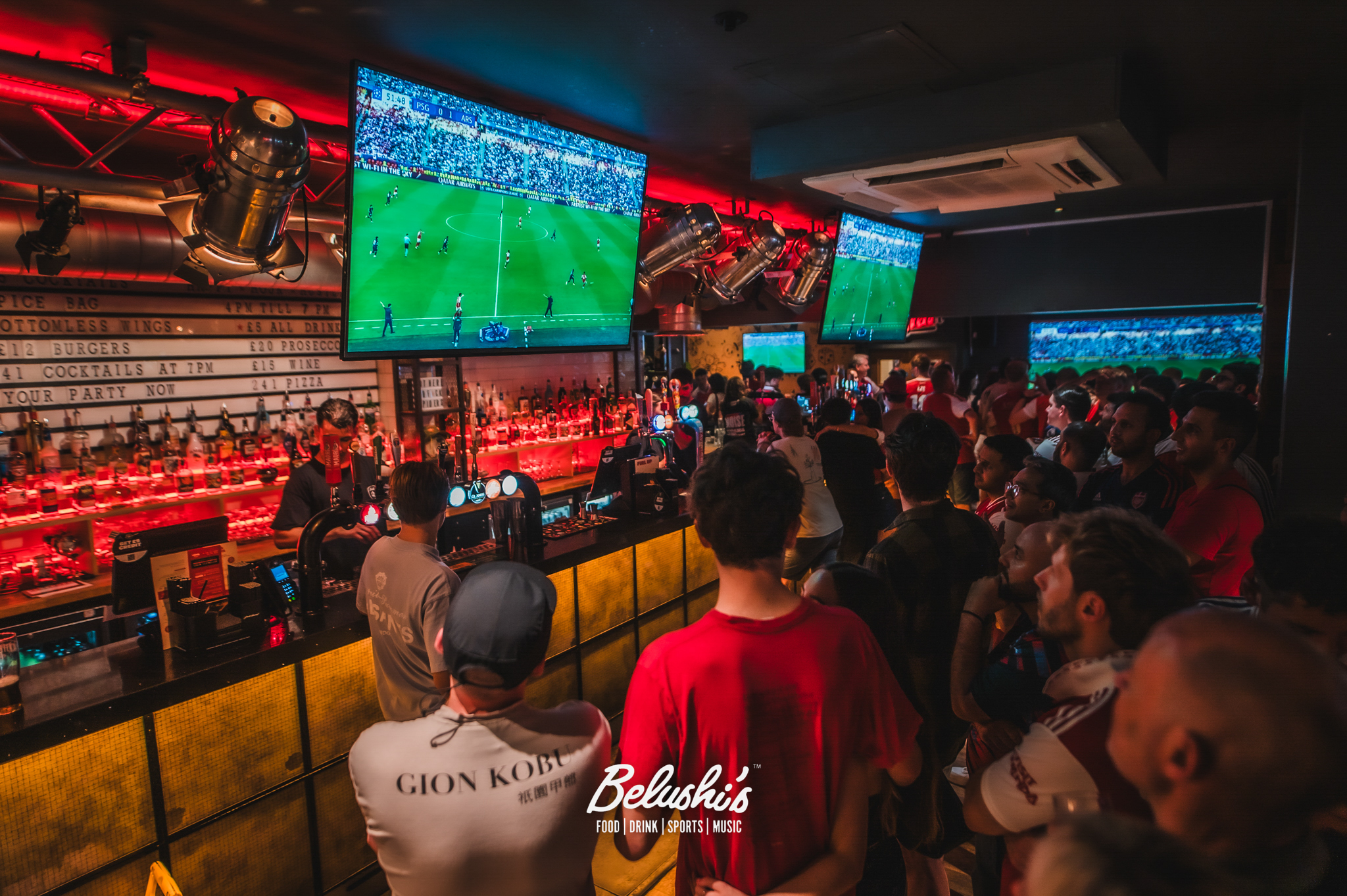
England’s next big tournament moment will not feel right on a laptop. These matches are built for noise, chaos, pints on the table, and a room full of strangers turning into one furious, hopeful mob.
That is the defining thread running through England football World Cup history. The wins matter. The heartbreak matters more than anyone would like. What lasts is the shared experience. People still talk about 1966 because it was glorious and because it belonged to the country for one wild afternoon. The near misses stuck for the same reason. They were lived together, argued over together, and dragged into every tournament that followed.
So treat the next one properly. Big games need big screens, clear sightlines, decent sound, food that keeps people in their seats, and drinks sorted before half the pub decides to order at once. Football is better when the room cares. Simple as that.
Belushi’s gets a factual mention here for a reason. It has venues across major European cities, which matters if you want a place built for live sport rather than a bar that sticks the match on in a corner and hopes nobody asks for the volume. Fans traveling or living in London, Paris, Amsterdam, Berlin, Vienna, Barcelona, Edinburgh, or Newquay know the difference straight away.
Planning matters too. England match demand gets stupid fast, especially once a tournament bracket opens up and everyone starts talking themselves into glory. Leave it late and you end up with a bad view, a dead atmosphere, or both. That is amateur hour.
If you are sorting a birthday, reunion, student night, or a proper football meet-up, pick the venue early, book the table early, and spare your group the usual nonsense. Nobody wants to spend a quarter-final squinting past a pillar while someone who does not care about football asks for the music back on.
The next chapter is coming. There will be a late winner, a ropey refereeing call, and at least one moment that makes the whole room forget how to breathe. Watch it with people. That is the whole point.



When you spend £5
Plus, earn 10p on every £1 you spend, claim a £30 bar tab on your birthday and unlock exclusive offers.
*European venues: amounts in €.